
Events
FIGIEFA organises various events with market operators, stakeholders and policy makers, to discuss and explain the needs and position of the wider aftermarket.

Partnerships
FIGIEFA is at the core of numerous alliances and forums working on the aftermarket issues. It allows us to play a leading role in the defence of the wider independent automotive aftermarket.
Publications
FIGIEFA publishes regularly different documents to explain and precise its position on various issues.
The Remote Service Supplier Community
The Remote Service Supplier (RSS) Community brings together leading providers of remote[SG1] automotive services across Europe. The Community’s members help workshops perform increasingly complex repair and maintenance operations through remote diagnostics, software programming, coding, calibration and technical support. Hosted by FIGIEFA, the Community promotes awareness of the essential role remote service suppliers play in maintaining safe, efficient and competitive vehicle repair services across Europe.
EU Presidency Outlook: Denmark
Join us for a timely discussion on Denmark’s priorities for its upcoming presidency of the Council of the EU, starting this July. Leading EU policymakers, including the Danish Coreper II Ambassador and two Danish Members of the European Parliament will explore – together with The Parliament’s editorial team and FIGIEFA – Denmark’s strategic vision for Europe in turbulent geopolitical times. Part of a recurring series marking each rotating presidency, this briefing debate and networking offers unique insights into the agenda and expected impact of the incoming mandate on EU policies.


The Automotive Aftermarket - Driving Force of Europe’s Competitiveness and Resilience
On 9 June 2026, the Automotive Coalition for Europe (ACE) will convene policymakers, industry leaders and stakeholders in Brussels for the launch of its Pan-European Campaign ‘We Drive EU’. At a decisive moment as Europe redefines its automotive and industrial priorities, this event will place the Automotive Aftermarket firmly on the policy agenda as a strategic pillar of Europe’s future. It will spotlight how the sector underpins Europe’s competitiveness and industrial sovereignty—powering the mobility transition, strengthening resilient supply chains, and delivering practical solutions for circularity, digitalisation and innovation. The event will demonstrate how an open, innovative, and economically viable aftermarket is indispensable to a resilient and competitive European automotive ecosystem, offering a unique opportunity to shape the policy debate. The programme will open with an institutional perspective from the European Commission, with a keynote by Mark Nicklas, Head of Unit Mobility, DG GROW, on ‘The Commission's policies to foster resilient supply chains.’ This will be followed by an address from Paulius Saudargas, Member of the European Parliament and rapporteur in the Committee on the Internal Market and Consumer Protection for the Regulation on circularity requirements for vehicle design and the management of end-of-life vehicles. Mr Saudargas will address how ‘Extending the lifecycle of the vehicle supports true circularity and a strong, innovative European Automotive Industry.’ A high-level panel discussion will then bring together representatives from across the aftermarket value chain to explore how the sector contributes to Europe’s competitiveness, sustainability and economic resilience — while delivering affordable and efficient mobility solutions for citizens, businesses and fleets across the continent. The event will conclude with key takeaways and a clear call to EU policymakers, followed by a networking cocktail and dinner reception, offering participants the opportunity to continue the discussion in an informal setting. All the information and registration here: https://events.euractiv.com/event/info/the-automotive-aftermarket-driving-force-of-europes-competitiveness-and-resilience
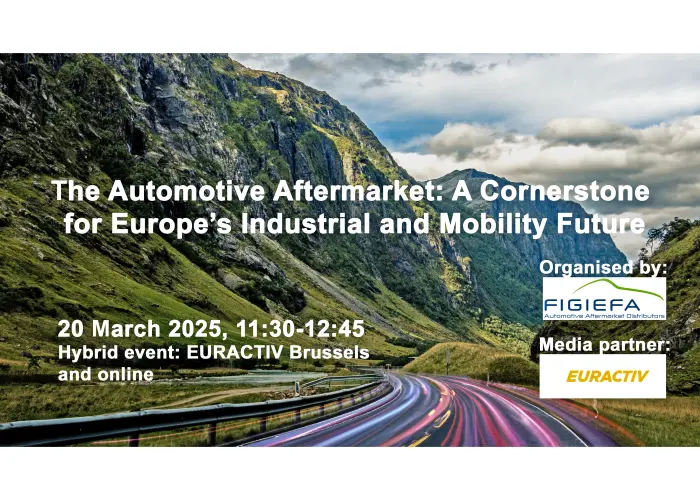
The Automotive Aftermarket: A Cornerstone for Europe’s Industrial and Mobility Future
The Automotive industry as a whole is living through systemic changes and challenges at an unprecedented pace. Technological developments in vehicle components, together with the exponential rate of its connectivity, are making manufacturing, driving, and repair and maintenance a different reality. At the same time, e-mobility solutions and the deployment of Electric Vehicles, as well as the arrival of an entirely new kind of engines and parts deeply impact the entire automotive ecosystem. One crucial part of the industry is navigating these changes with steady force and leading in innovation and circularity practices: the Independent Aftermarket (IAM). In the current geopolitical incertitude, rising trade wars and protectionism, the European Commission has established as one of its main priorities for the starting mandate the reinforcement of the automotive industry and European companies' competitiveness and will announce its new Automotive Industrial Action Plan on the 5th of March. In this context, the IAM in general and parts distribution and wholesaling in particular, represented by FIGIEFA, call on a holistic approach of the entire automotive ecosystem for this Action Plan and future European legislation. The Roland Berger Aftermarket Panorama study that will be presented at this event will show the extent to which the IAM is capital in driving the sector and the whole industrial competitiveness for Europe, together with an unmatched economic and societal impact. In the aftermath of the publication of the European Commission Automotive Industrial Action Plan, which is expected on the 5th of March, we will assess what is ahead of us by bringing the voice of the IAM industry, consumers, and policymakers together. We will offer a vision of the positive and constructive contribution our sector can make to achieving a thriving industrial future for Europe. Register here: https://events.euractiv.com/event/info/media-partnership-the-automotive-aftermarket-a-cornerstone-for-europes-industrial-and-mobility-future

FIGIEFA CONFERENCE 2024
Our FIGIEFA 2024 Conference, taking place on the 23rd and 24th of October in Brussels at the Renaissance Hotel in Brussels, will provide an analysis of the political situation in Brussels with the new European Parliament and the new Commission. Also, keynote presentations will address current trends in the European automotive aftermarket landscape, provide an update on market facts & figures and examine the role of artificial intelligence in this sector. This will set the stage for discussions on what is needed to remain competitive in the market for services supporting affordable mobility for consumers and business operators alike. We will welcome attendees to a cocktail & dinner on the evening of the 23rd of October. This will be an opportunity to network with FIGIEFA’s independent parts/ distributor, wholesaler & trade group community, industry peers, and sector association colleagues. Please contact figiefa@figiefa.eu if interested to attend.
FIGIEFA CONFERENCE 2026
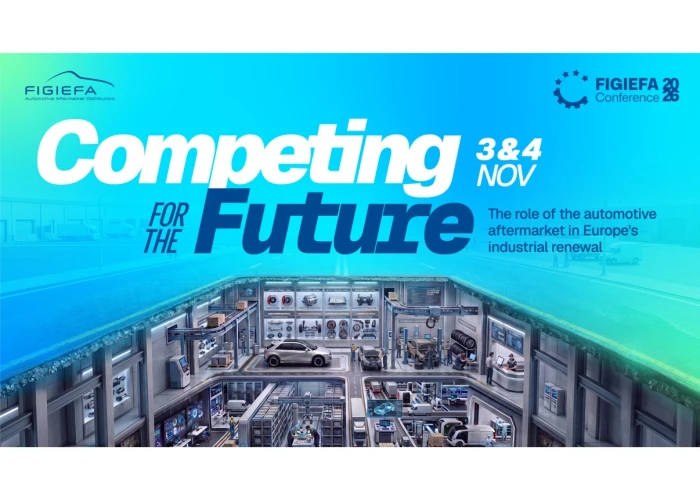
Our 2026 Conference, taking place on November 4 in Brussels, is still open for registrations. The event will take place at the DoubleTree by Hilton Hotel for both the networking dinner on the 3rd and the 4th plenary session. The conference will provide an analysis of the political situation in Brussels two years into the new European Parliament and Commission. Keynote presentations will address current trends in the European Automotive Aftermarket landscape, provide an update on market facts & figures and examine the role of Artificial Intelligence in this sector. This will set the stage for discussions on what is needed to remain competitive in the market for services supporting affordable mobility for consumers and business operators alike. We will welcome attendees to a cocktail & dinner on the evening of November 3. This will be an opportunity to network with FIGIEFA’s independent parts distributor, wholesaler & trade group community, industry peers, and sector association colleagues. Interested in attending? Reach out to alvaro.delacruz@figiefa.eu to obtaing your ticket. HERE IS THE FULL PROGRAMME OF THE EVENT:
Vehicle Maintenance, Service and Repair During the Warranty Period
Practical guide for independent aftermarket operators and consumers
FIGIEFA Manifesto 2024-2029
You will find here our 5 working pillars for the currently starting European political mandate: https://acrobat.adobe.com/id/urn:aaid:sc:EU:06132649-1a98-451d-bfc4-691fdcea25f0

Competitiveness in the Automotive Aftermarket in the Context of the Technology Shift
This is a recent study developped by Berylls in collaboration with CLEPA and FIGIEFA. The automotive sector is one of the most relevant contributors to the wealth of European citizens. In the past, a highly competitive aftermarket granted affordable and individual mobility to a large part of the population, but this might change with the ongoing shift of technology. CLEPA, FIGIEFA, Automechanika, and Berylls conducted a study to analyze the most important influencing factors that have the potential to change the aftermarket landscape and possibly drive a shift in the existing market balance between the channels of the independent aftermarket (IAM) and the original equipment services (OES). To substantiate and draw conclusions, we identified five key influencing factors likely to drive the most significant changes and defined seven key markets in Europe to provide a thorough overview and subsequently build a market model to forecast the expected market development. We conducted interviews with highly esteemed experts across the entire aftermarket value chain to gather qualitative feedback, sustain our observations, and illustrate changes in the balance of power, price, and access to data, forming highly probable market scenarios. Download the full study now: https://www.berylls.com/wp-content/uploads/2024/09/Berylls-Aftermarket_Insight_2024_vf.pdf
European Independent Automotive Aftermarket Panorama
This is a recent study developped by Roland Berger in collaboration with FIGIEFA. The automotive industry sector is one of Europe's key economic sectors and the third-largest spending category by consumers, after housing and food. Within the industry sector, the aftermarket plays a crucial role in supporting the use, maintenance and repair of vehicles. It represents a market of around EUR 118 billion in parts alone within the European Union, of which the multi-brand independent aftermarket (IAM) makes up EUR 73 billion or around 62%. The IAM is particularly important when it comes to parts, servicing and repairs for vehicles that are more than four years old – around 195 million vehicles, or 70% of those currently on European roads. Why, then, is the multi-brand independent aftermarket sometimes viewed as something of an afterthought within the industry? It represents a key profit pool for Europe's automotive sector, enables road-based mobility, maintains essential service vehicles, keeps mobility affordable and improves the sustainability of road-based transportation. Indeed, its role is fundamental throughout the vehicle lifetime – and we believe that it deserves greater recognition as a key element of the value chain within the industry. For the purpose of this report, we surveyed more than 380 members of FIGIEFA, the European Federation of Independent Automotive Aftermarket Distributors, located across Europe. Based on the results of this survey and additional interviews with the chief executive officers of more than two dozen major independent parts distribution groups, corporates and FIGIEFA national member associations, combined with the expertise of Roland Berger's specialists, we identify a number of key trends in the market. In this report, we present the results of our investigation and our insights into how the role of the IAM may change in the future, arguing the case for why the IAM needs to be rebranded in a way that recognizes its vital place in the automotive industry – as an active contributor to Europe's competitiveness and the European economy as a whole. Download the full study now: https://content.rolandberger.com/hubfs/07_presse/European%20Independent%20Automotive%20Aftermarket%20Panorama_final.pdf
Powering Europe forward - Why the independent automotive aftermarket matters more than ever
The independent automotive aftermarket (IAM) makes a far greater contribution to Europe’s economy and mobility than its direct market volume of around EUR 100 billion in spare parts sales would suggest. This is the finding of a new study by Roland Berger and FIGIEFA, which quantifies the IAM’s wider economic benefits for the first time. By providing affordable maintenance and repair, the IAM enables an estimated 314 billion additional vehicle kilometres each year. At the same time, lower total costs of vehicle ownership and higher vehicle residual values increase consumers’ potential budget for new cars by around EUR 65 billion. Shorter vehicle downtimes generate an additional economic benefit of approximately EUR 23 billion per year. “The independent automotive aftermarket is far more than a market for repairs and spare parts. It keeps mobility affordable, increases vehicle residual values and reduces economically costly downtime,” says Maximilian Wegner, Principal at Roland Berger. “This makes the IAM an important pillar of the competitiveness of both the European automotive industry and the wider economy.” The IAM comprises a Europe-wide network of independent parts manufacturers, parts wholesalers, repair shops and other service providers such as multi-brand diagnostic tool producers, data publishers or remote service providers. They all keep the 332 million vehicles in Europe mobile. With a market share of around 64 percent, up from approximately 62 percent in 2021, it remains the largest service channel in the European aftermarket. At the same time, maintenance and repair are becoming increasingly important since the lifespans of vehicles are extending: The average age of passenger cars in Europe rose from 11.9 years in 2020 to 12.9 years in 2024. “The independent parts distribution sector has undergone a profound transformation over the last decade. It is no longer a supply chain moving parts from one location to another. Today it is a highly interconnected ecosystem that integrates data, diagnostics, (remote) technical support and digital tools alongside with efficient parts logistics and distribution. This evolution is supporting independent operators adapt to new vehicle technologies and continue providing high-quality services to vehicle owners across Europe", says Sylvia Gotzen, Chief Executive of FIGIEFA. The independent automotive aftermarket benefits consumers and vehicle manufacturers alike: Competition and a dense service network reduce maintenance and repair costs, lowering the total cost of vehicle ownership. With the same mobility budget, lower operating costs enable around 314 billion additional vehicle kilometers per year – an increase of nine percent. At the same time, reliable and cost-effective repair options support vehicle residual values. This reduces the effective depreciation borne by consumers and can leave them with a larger disposable income and budget for their next vehicle purchase – around EUR 65 billion per year. At the same time, the dense network of independent repair shops and parts distributors complements vehicle manufacturers’ own service networks and ensures broad geographic coverage. For established European manufacturers, this mature infrastructure is an advantage over new market entrants, which first need to build comparable repair and service capabilities. Technological change pressures the independent aftermarket Meanwhile, electrification and software-defined vehicles are fundamentally changing replacement parts supply and maintenance, as well as repair services. Work on high-voltage batteries or thermal management systems requires new tools, diagnostic equipment, protective gear and specially trained employees. Software diagnostics, updates and the calibration of advanced driver assistance systems are also becoming increasingly important. For many of these tasks, independent repair shops need access to manufacturer-specific vehicle data and software systems. However, cybersecurity requirements and differing access and authentication procedures add complexity. If access is too technically demanding or not economically viable, this can restrict competition and limit independent businesses’ ability to carry out competitive repairs. To safeguard the IAM’s economic and social contribution over the long term, the study identifies three key areas for action: 1. Build technical capabilities for new generations of vehicles: Independent repair shops need to invest in training, diagnostic equipment as well as tools for electric mobility and software-based repairs. Independent parts wholesalers and repair-shop networks can also make these capabilities accessible to smaller businesses. 2. Ensure practical access to vehicle data and software functions: A robust and ‘update to technical progress’ regulatory framework is needed to ensure non-discriminatory access. Vehicle manufacturers must provide access that is secure, easy to use and economically viable. 3. Improve efficiency across the value chain: Vehicle manufacturers, suppliers, independent parts distributors and repair shops need to collaborate more closely so that spare parts are immediately available and repairs remain fast and affordable. Digital solutions and AI help repair shops identify faults more quickly and get vehicles back on the road sooner. The full study is available for download here: https://www.rolandberger.com/en/Insights/Publications/Powering-Europe-forward.html
FIGIEFA Activity Report 2024
The year 2024 marked a significant institutional and political shift for the European Union. With the election of a new European Parliament in June and the appointment of a new European Commission later in the year, a fresh five-year cycle (2024–2029) has begun, defined by growing economic pressures, technological transitions, and the urgent need to secure Europe’s competitiveness and strategic autonomy. At the heart of this renewed vision are two influential policy frameworks: the Letta Report on the Future of the EU Single Market and the Draghi Report on EU Competitiveness. These documents call for a more integrated, sovereign, andinnovation-driven Europe, one capable of mastering its green and digital transitions while avoiding deindustrialisation. In particular, the Draghi Report calls for a bold EU strategy to boost competitiveness by closing the innovation gap, aligning green transition goals with industrial strength, and enhancing strategic autonomy. It recommends major investment and institutional reforms to achieve these objectives. In parallel, the European Commission has launched work on a new European Automotive Industry Action Plan, expected to be unveiled in 2025. This initiative reflects a growing recognition that the automotive ecosystem, including the Independent Automotive Aftermarket, must play a pivotal role in the EU’s competitiveness, decarbonisation goals, and consumer choice frameworks. The Action Plan will likely define the enabling conditions for innovation, access to data, circularity, and SME resilience—core issues for FIGIEFA’s mission. Externally, 2024 was shaped by escalating geopolitical instability, from the ongoing war in Ukraine and the Middle East conflict to rising global protectionism and supply chain fragility. In this tense context, the EU’s quest for open strategic autonomy has accelerated. FIGIEFA and the broader IAM sector are positioned as essential contributors to this goal—ensuring diversified sourcing, competitive repair services, and resilience in mobility. As this new EU mandate begins, the independent aftermarket faces both a challenge and an opportunity: to assert its strategic value in policy debates and embed its voice into the architecture of Europe’s economic and industrial future. FIGIEFA’s2024 work laid strong foundations for this task.
FIGIEFA Activity Report 2025
2025 began with a renewed EU institutional cycle and heightened political focus on restoring Europe’s competitiveness. With the new Parliament and Commission in place, the EU set out priorities centred on industrial resilience, digital transformation and strategic autonomy — all of which directly influence the Independent Automotive Aftermarket (IAM), and particularly parts distribution and wholesale. For FIGIEGA, the Commission’s decision to launch the Strategic Dialogue on the Future of the Automotive Industry was a great challenge to ensure a full‑value‑chain approach. For the IAM, this was a critical opportunity: to place the aftermarket within discussions originally dominated by manufacturing, highlighting that Europe’s mobility competitiveness depends not only on vehicle production, but equally on the networks that supply, repair and maintain the continent’s 280 million vehicles. Parts distributors played a prominent role in emphasising how stable sourcing, efficient logistics, and competitive multi‑brand repair are essential to affordable mobility. Several political trends in 2025 had immediate consequences for parts wholesalers. The rise of software‑defined vehicles tightened OEM control over technical information and parts configuration, increasing the urgency for clear rules on access to vehicle data. Electrification and new expectations on battery repair and reuse also reshaped product portfolios and logistics needs. At the same time, the EU’s growing circular‑economy agenda — from digital product passports to end‑of‑life rules — began redefining how parts move across borders and how information must accompany them throughout the supply chain. These dynamics framed FIGIEFA’s core priorities in 2025. Securing a robust Sector‑Specific Legislation on Access to In‑Vehicle Data remained essential to prevent market fragmentation and ensure distributors can support increasingly complex vehicles. Work on the revision of Type‑Approval Regulation 2018/858 continued to focus on safeguarding access to diagnostic pathways, ADAS and EV battery repair information — key to maintaining competitive multi‑brand parts supply and workshop operations. Meanwhile, the implementation of the newly adopted EU Repair Clause began to shift competition conditions in visible spare parts markets, reinforcing consumer choice. Parts distribution also gained visibility in EU debates on supply‑chain resilience, with policymakers increasingly recognising wholesalers as a pillar of operational continuity — particularly in a context of geopolitical tension and global dependencies. The publication of the Automotive Industrial Action Plan confirmed that the Commission now acknowledges the full lifecycle of the automotive sector, though further work is needed to ensure aftermarket‑relevant measures are integrated systematically. In this evolving landscape, 2025 became a pivotal year. Europe’s political priorities moved closer to recognising the IAM as a strategic asset, while FIGIEFA worked to ensure that this recognition is translated into future‑proof legislation. For parts distributors and wholesalers, the year underscored a fundamental truth: Europe cannot achieve competitive, sustainable and affordable mobility without a strong and fully empowered Independent Automotive Aftermarket.
New Competition Law Framework
Brochure – The new competition law framework for the automotive aftermarket – Right to Repair Campaign, 2010
Free Flow of Data
Brochure 2016 – Free Flow of Data – Commission Communication – Input from the Independent Automotive Aftermarket
Updated Ricardo Survey of 09-2017 on Access to RMI for parts identification
Parts Identification Survey – Final Report
OEM 3rd Party Telematics – General Analysis
To assess the technological feasibility of guaranteeing fair and undistorted competition in the automotive digital aftermarket, several European associations representing independent operators and consumers have commissioned a study to Knobloch & Gröhn, a technology consultancy.
Policy Event – Connected mobility services at the crossroads – Now, which route to take?
Europe is on its way to connected and automated driving, and vehicles become the new mobility and services hub. This puts the EU at a crossroads: Will the future market for connected and automated mobility in general still be able to support innovation, competition and consumer choice?
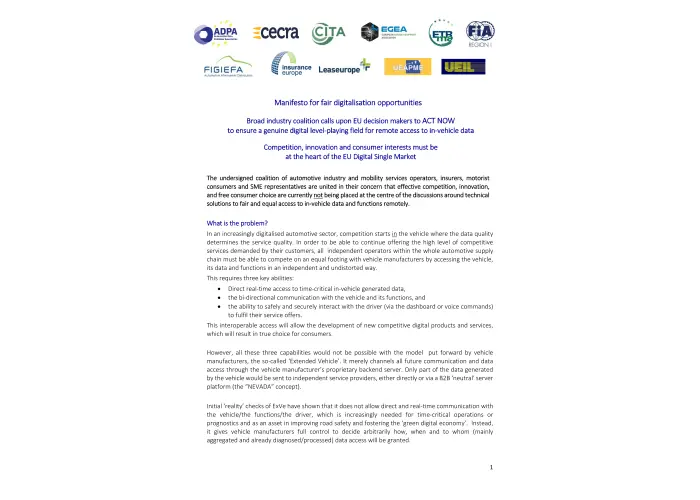
Manifesto for fair digitalisation opportunities
Broad industry coalition calls upon EU decision makers to ACT NOW to ensure a genuine digital level-playing field for remote access to in-vehicle data.Competition, innovation and consumer interests must be at the heart of the EU Digital Single Market.
Manifesto for Fair Digitalisation Opportunities
Broad coalition calls upon EU decision makers to put forward legislation by 2020 ensuring a genuine digital level-playing field for remote access to in-vehicle data and functions.
FIGIEFA provides its feedback on the roadmap for the evaluation of the Motor Vehicle Block Exemption Regulation
FIGIEFA is pleased to comment on the evaluation roadmap and confirms the important role of the sec-tor specific rules for maintenance & repair services and the distribution of spare parts. The MVBER and the Guidelines provided in practice protection against a number of distortions. Both currently serve as an important framework which allows e.g. OE parts producers to supply independent parts distributors and the independent and authorised aftermarket. Also, parts suppliers’ right to brand their OE products with their own logo (dual branding) and the definition of ‘original and matching quality parts’ has an important effect in the market helping to demonstrate the true origin and quality of parts to consumers and their competitive choices. Hence, hard-core restrictions serve an important purpose.
Survey – Impact of COVID-19 on independent spare parts distributors
The COVID-19 had a fast and disruptive impact on the European Union, its people and its companies. The unprecedented human impact is closely followed by an important economic and social shockwave, which magnitude can be compared with the 2007 financial crisis, if not more. Necessary lockdown measures had a huge and immediate impact on the consumption of households, which could be reinforced in the near future with the job losses. SMEs, with limited liquidities, are particularly at risk.
FIGIEFA contribution to the EDPB consultation on draft guidelines for data privacy in the context of connected vehicles
We welcome the EDPB Guidelines which bring important clarifications on the processing of personal data in the context of connected vehicles and mobility related applications.
Euro VI Heavy Duty Vehicles type-approval legislation
Brochure – Access to vehicle repair & maintenance information for heavy duty vehicles – AFCAR Alliance, 2011
Cyber-Security Concept for a secure Onboard Telematics Platform
Connected vehicles offer the the possibility to exchange data with different actors, in particular automotive suppliers, e.g. for remote and predictive maintenance and repair. In order to allow communication with multiple partners, an Open Telematics Platform (OTP) needs to be implemented on vehicles, enabling multiple parties to access the vehicle data. The remote access to vehicle needed to enable such services yield various attack surfaces. For instance, an unauthenticated party may access private vehicle data (e.g. the driver’s route history). In order to address these attacks surfaces, the UNECE WP29 and the ISO/SAE 21434 require OEMs, suppliers and parties accessing the vehicle to establish security risk management supporting the vehicles security lifecycle on technical and organizational level. On a technical level, a set of cybersecurity measures must be implemented to restrict the vehicle access to authenticated parties and to manage this access for the whole lifecycle of the vehicle. On an organizational level, processes to assess risks and treat them according to their severity are required.
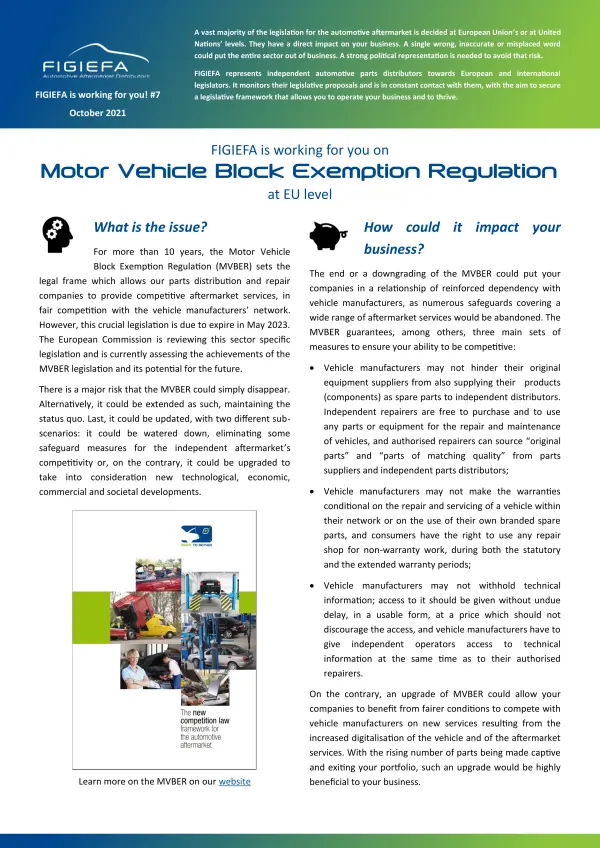
FIGIEFA is working for you…
A vast majority of the legislation for the automotive aftermarket is decided at European Union’s or at United Nations’ levels. They have a direct impact on your business. A single wrong, inaccurate or misplaced word could put the entire sector out of business. A strong political representation is needed to avoid that risk.
Creating a level playing field for vehicle data access: Time for an ambitious legislation!
Brussels, 13 September 2021 – Ahead of the European Commission’s Workshop on “Access to In-Vehicle Data” on 17 September 2021, a broad coalition representing automotive aftermarket operators, vehicle dealers, mobility services and consumers urges the European Commission to publish an ambitious legislative proposal on access to in-vehicle data by the first quarter of 2022 at the latest.
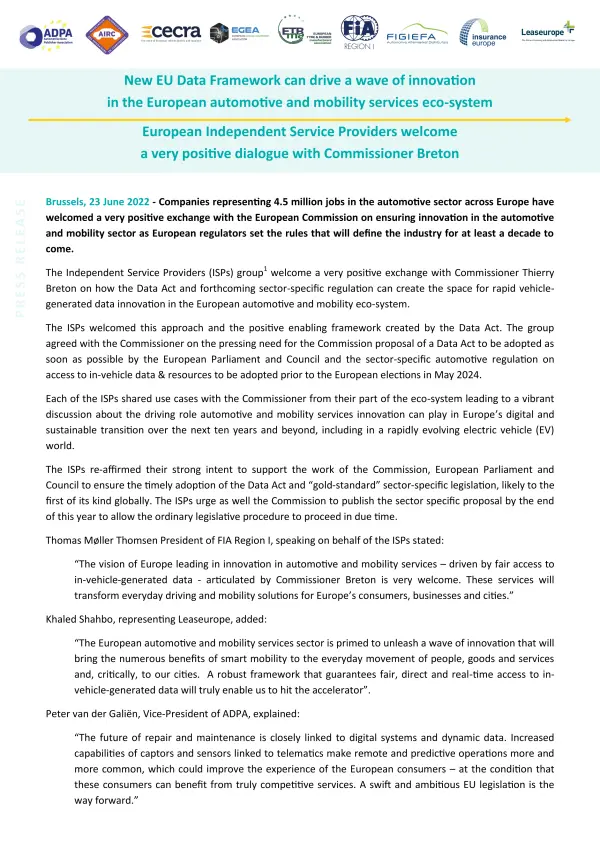
New EU Data Framework can drive a wave of innovation in the European automotive and mobility services eco-system
European Independent Service Providers welcome a very positive dialogue with Commissioner Thierry Breton

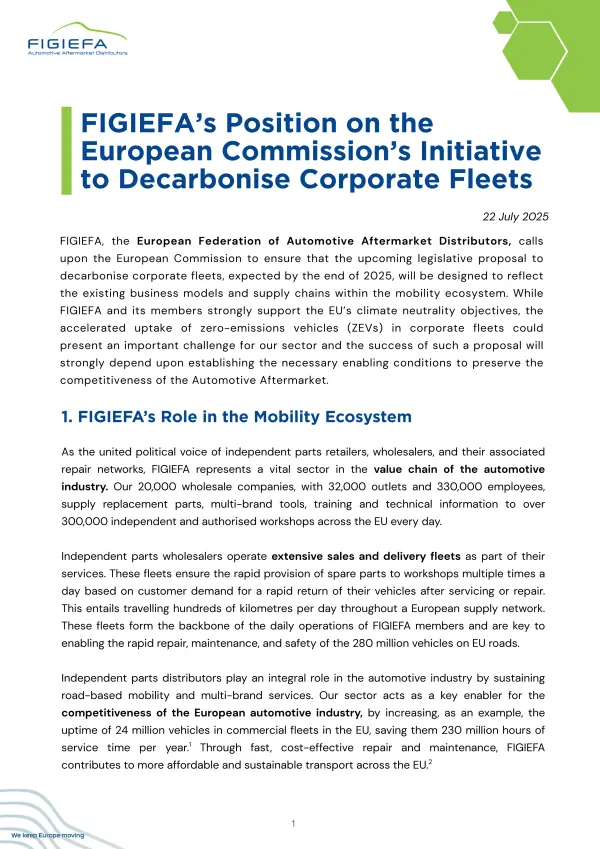
FIGIEFA’s Position on the European Commission’s Initiative to Decarbonise Corporate Fleets
Last week, EU Commissioner for Sustainable Transport and Tourism Apostolos Tzitzikostas hosted a High-Level Strategic Dialogue with stakeholders to discuss the Greening Corporate Fleets initiative.
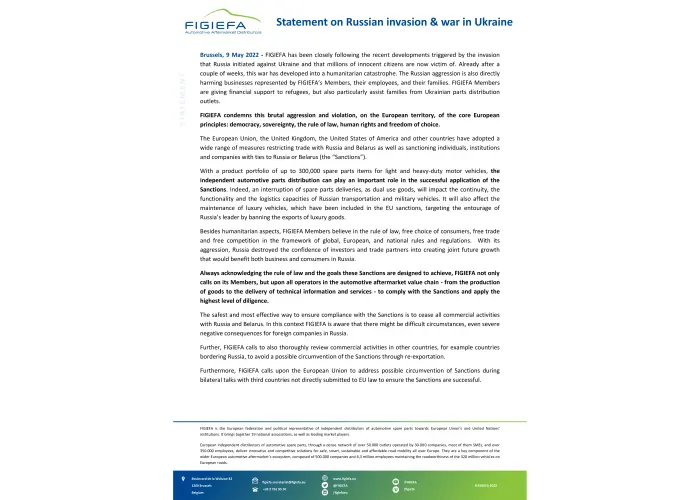
Statement on Russian invasion & war in Ukraine
Brussels, 9 May 2022 - FIGIEFA has been closely following the recent developments triggered by the invasion that Russia initiated against Ukraine and that millions of innocent citizens are now victim of. Already after a couple of weeks, this war has developed into a humanitarian catastrophe. The Russian aggression is also directly harming businesses represented by FIGIEFA’s Members, their employees, and their families. FIGIEFA Members are giving financial support to refugees, but also particularly assist families from Ukrainian parts distribution outlets.
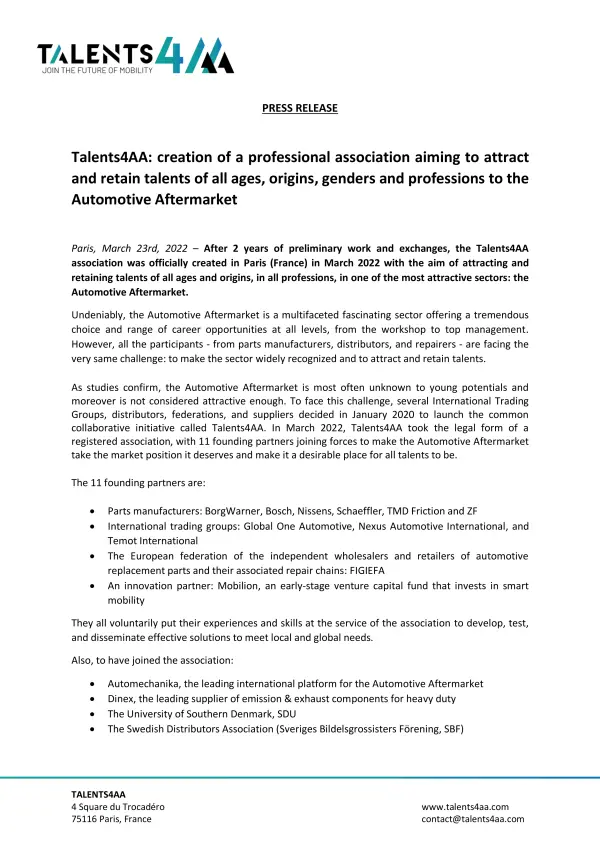
Talents4AA: creation of a professional association aiming to attract and retain talents
Paris, March 23rd, 2022 – After 2 years of preliminary work and exchanges, the Talents4AA association was officially created in Paris (France) in March 2022 with the aim of attracting and retaining talents of all ages and origins, in all professions, in one of the most attractive sectors: the Automotive Aftermarket.
European Commission’s proposal for Data Act welcomed, but robust automotive-specific legislation urgently required
Brussels, 23 February 2022 – A broad coalition representing a wide range of major automotive aftermarket stakeholders, as well as operators in the mobility services value chain, consumers, the insurance and the tyre industries welcomes today’s publication of the proposal by the European Commission for a European Union’s Data Act.